
Your clear path to understanding
Welcome to circularlearning, your dedicated space for secondary Health and Physical Education (HPE). We're here to support your understanding before performance, preparing you for ATAR-style literacy and assessment, all while nurturing calm, focus, wellbeing, and equity. Start your journey with us and discover a new way to learn.
Welcome!!!
pp
Circular learning is a supportive low-stimulation learning space.
Our cyclical approach allows you to move forward knowing that we revisit concepts as needed
This ensures deeper understanding.
Students are asked to scroll all the way down to Tasks 1-4 but reflect on the past unit learnings about Oxyen exchange...
Look Back Week on the week that was...
WEEK 1-2 Cycle -1 narrative
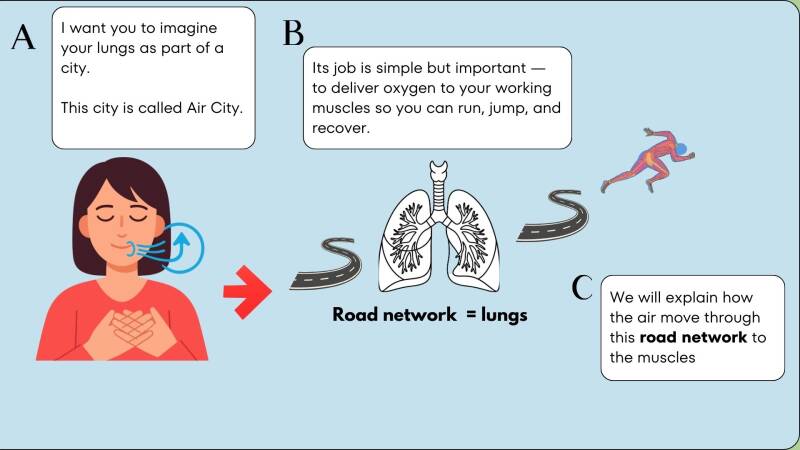
Air City Narrative
This is an example of a story providing a sequence for learning.
This story is designed to help you see how the respiratory system works as a whole.
In this phase we aren't expected to memorise terms or write perfect answers.
We notice things like
-
where air travels
-
where it slows down or changes direction
-
or where oxygen leaves the air and enters the blood
We notice what is familiar or confusing
For a low stakes activity.
-
Used a Peel document to organise their thoughts
This helped with the more technical lecture that followed
WEEK (2-3) Cycle2 -Atar-Style lecture
Class overview
In the previous section, you used the Air City story to build a shared understanding of how the respiratory system works.
That work was about noticing — seeing where air goes, where exchange happens, and how the system fits together.
In this section, we move into explanation and application.
We will use the same story, but in a different way:
-
not to introduce new parts
-
but to help explain how oxygen supply and demand change during exercise and recovery
This is where we connect the story to the formal concepts used in VCE Physical Education, such as oxygen uptake, oxygen deficit, steady state, and EPOC.
The expectations are slightly higher here, but the task is not new.
You will use the same detective tools — noticing, naming evidence, and linking ideas — to explain what is happening using more scientific language.
Reflect on how we used the PEEL worksheet to take notes. This will help you in your upcoming tasks
below is the worksheet and the lecture
Task 1-4: Inquiry Tools & Perspectives
These curated resources are presented as a connected series. Together, they show how learning in Physical Education begins with observation and noticing, is supported by thinking tools, and is strengthened by different ways of knowing. You are not expected to master everything at once — the goal is to gradually build understanding over time. When you have watched the video put a thumbs up in the comment section...
Task 1: Watch and Notice
This short video tells the story of how oxygen moves through the lungs and into the blood.
As you watch, focus on noticing rather than memorising.
Listen for what is happening and the order it happens in. You don’t need to write everything down — just pay attention to the key idea you’re listening for.
After the video, you’ll complete a quick Noticing Check to show what you noticed and how the process connects from one step to the next.
Take your time. Notice first. Organise later.
Task 2: Organise what
you noticed
You’ve already watched the gas exchange story and practised noticing what was happening.
Now, you’re going to organise that noticing.
This is where the PEEL framework comes in

The story gives you the sequence of events.
The word bank in the organiser helps you name what you noticed.
PEEL also helps put it together clearly.
You are not starting from scratch.
You are working with what you already noticed.
How to Use This Step
-
Revisit the Point provided in the form.
This tells you what to focus on. -
Use the word bank in the form to help you describe what you saw or heard in the video.
If you weren’t sure the first time, that’s expected — this is where clarity builds. -
Organise your thinking using PEEL using the organiser
-
P – The idea you are focusing on
-
E – What you noticed in the video
-
E – How that supports the idea
-
L – What happens next in the process
Afterwards, fill out the form to Guage your understanding.
Task 3: PEEL/TEEL for Critical Inquiry
Read the article, "Appetite for convenience: how the surge in online food delivery could be harming our health"

How to Use This Article
This article is not something to memorise.
It’s something to work with.
Instead of reading everything, focus on the main ideas and how they connect.
Step 1: Identify a Point
Look for a clear idea you can make a claim about, such as:
-
Online food delivery increases access to fast food
-
Convenience and marketing influence food choices
-
Health is shaped by systems, not just individual decisions
You only need one clear point to begin.
Step 2: Notice the Evidence
Find one or two statistics or examples that support your point.
These might include:
-
Percentages of fast-food availability
-
Marketing tactics used in delivery apps
-
Trends in usage since COVID-19
You don’t need lots of evidence — just enough to support your idea.
Step 3: Choose an Inquiry Direction
You can take your thinking in different directions, for example:
-
Health & behaviour: How convenience shapes choices
-
Systems & environment: How apps and marketing influence health
If you notice a different angle that makes sense, you are free to use it.
Step 4: Organise Using TEEL (or PEEL)
TEEL and PEEL are very similar — they both help you organise thinking before writing.
-
T / P — What is your main idea or claim?
-
E — What evidence from the article supports it?
-
E — How does that evidence explain or prove your point?
-
L — What does this lead to, or why does it matter?
This time, instead of a single scientific process, you are organising a story about systems, behaviour, and health. Use the form to submit your response

Task 4: Mindfulness Of Sound
In this activity, sound is your Point.
-
Instead of noticing everything at once, you are narrowing your attention to one thing:
sounds as they come and go. -
You are not trying to control your thoughts
You are practising focusing by choosing what to notice. -
This is the same skill used in learning and PEEL writing:
first decide what you are focusing on (the Point),
then notice information that relates to it.
By narrowing attention to one clear Point, this practice helps calm busy thoughts, reduce overload, and support emotional regulation before higher-demand learning.
Reading the Padlet
Take a moment to read a few responses from others.
Notice similarities, differences, or ideas you hadn’t considered.
Replying is optional as you can just observe how learning can look different for different people. Remember to be supportive to each other.
.

Add comment
Comments